Your basket is currently empty!
Tag: cryptocurrency
-

The Decline of Bitcoin in the Age of Stablecoins and Quantum Computing
In the last few weeks, Bitcoin has steadily taken a fall with a value once surpassing $126 296 declining to USD87 390 at an over 30% decline.
Bitcoin – once thought infallible in the cryptoworld, is now beginning to attract skepticism for investors. While not an indictment of blockchains or cryptocurrencies, it serves a stark reminder that nothing is too big to fail.
In this article, we’ll explore the reasons behind the current decline of Bitcoin, and what the alternatives are.
The Last Few Weeks in Review
On October 6 2025, Bitcoin reached its zenith in terms of value with valuation USD126 296. This was the highest Bitcoin ever traded…and then it crashed.
Satoshi Nakamoto, the elusive founder of Bitcoin’s own personal Bitcoin shrunk to USD96.129 billion losing USD42.79 billion of his fortune. It was estimated before that if Forbes counted anonymous figures like Nakamoto, he’d be high up among the list of the world’s richest people. At present, he now would rank number 20, below Bill Gates and above Fracoise Bettencourt Meyers & Family.
In addition, Bitcoin has shed almost USD800 billion since October, leading towards its worst month since 2022.
Mitigating Factors
The are several contributing reasons for Bitcoin’s slump, which unfortunately could have been predicted by market watchers with keen eyes.
The first factor is macroeconomic factors – US Federal Reserve interest rate cuts are dragging down speculative assets like Bitcoin. Cryptocurrencies are traded usually as high-risk tech assets, and when traditional risk assets like tech and AI stocks are weak, speculative cryptocurrencies tend to under-perform.
Volatility is also a huge factor – thinner order books after the flash crash in October related to the renewed trade war concerns between the United States of America and the People’s Republic of China. This has led to think liquidity.
There is also an increase in consumers favouring stablecoins, especially in developing regions. This is logical, as stablecoins are backed by assets that have established monetary values like fiat currencies or rare precious materials.
The result? Increased ETF outflows such as on a single day in November when net outflows exceeded USD900 million, forcing funds to sell Bitcoin to meet redemption. Short-term traders and long-term investors are selling into any bounce attempt and locking in profits after significant gains respectively, thus creating a bearish sentiment.
There’s also another huge factor though.
Day Zero
Quantum Computing is advancing rapidly. Presently, more and more of the available Bitcoin is susceptible to quantum computer attacks, last at 25% earlier this year.
The moment a Quantum Computer can solve an algorithm known as Shor’s Algorithm in under 10 minutes, all Bitcoin and the entire network will be vulnerable to intrusion.
Community maintainers are already scrambling to work out a solution – should they freeze all operation on the Day Zero when Bitcoin is entirely vulnerable to quantum computers, or should they fork the project? Or both?
The Elpis
Much like the myth of Pandora in Greek mythology of old where all the evils were released from a jar, hope remained behind to comfort humanity.
NIST has released it’s finalists last year for Post-Quantum Cryptography algorithms. Stablecoins are an option…and that’s what we’re doing.
With our blockchain and cryptocurrency, we already have built-in Post-Quantum Cryptography based on the NIST standard along with plans to peg our token to gold after launching in a phased approach.
This could result in a stable medium worldwide, especially in developing countries, which simultaneously being future-proof against quantum attacks.
Could this be our cornucopia of the crypto world? Time will tell, but the probability is high.
Should our projects interest you, and you’re interested in partnership or investment, feel free to reach out via email at technical@coinafriq.org or phone +27626404965 (available on WhatsApp too).
We thank you for reading this article.
-

A New Way to Invest in Africa’s Future
Coin Afriq is a South African startup aiming to change the way finance works across the continent. While many cryptocurrencies and blockchains (a distributed public ledger) are built without considering Africa’s unique challenges, our project is designed specifically with our experience as people born and raised here. We believe these new technologies don’t have to be scary and can truly benefit many people.
Why Cryptocurrency?
Traditional banks have often failed many communities in Africa. Access to banking and lending facilities is limited, which makes it hard for many to meet their basic needs. Cross-border payments, which many families rely on, are slow and costly with traditional institutions. We’ve also seen the devastating effects of hyperinflation, as in Zimbabwe, where a simple item like bread can cost millions.
Crypto, and Coin Afriq specifically, offers a solution. All you need is internet access, which is widely available on mobile devices across Africa. Payments are much quicker and cheaper. Furthermore, because it’s not subject to centralized banks, it’s not affected by the conflict or corruption that can directly cause inflation.
The Growing African Crypto Market
The crypto market in Africa is experiencing significant growth. By 2026, it’s projected that there will be 77.76 million users in Africa, up from a current 5.50% of the population to 5.90%.
This growth represents big money. The revenue of the crypto market in Africa is currently around $4.8 billion (R84.46 billion), and it’s projected to grow by 6.75% annually. By 2026, this could reach $5.1 billion (R89.74 billion).
This trend shows that more and more people are adopting crypto, especially in South Africa and Nigeria, where regulations are being developed to ensure user safety.
What Makes Coin Afriq Different?
Our team is from Africa, and our project is designed to help the average person. You don’t need to be a tech genius or have a lot of wealth to participate—just a phone or computer and an internet connection.
Our coin is unique because it rewards users based on their merit and reputation. Participants who validate transactions are democratically voted for using a system called Nominated Proof of Stake (NPoS). What truly sets us apart is our focus on integrating with traditional finance; our project is being built to seamlessly connect with banks using a new standard called ISO-20022. This means you can participate without needing expensive, energy-consuming computer equipment.
The Benefit for Early Adopters
Once we are ready to go to market and have ensured full regulatory compliance, we will hold a pre-sale at R6.80 ($0.39) per coin. Our projected launch price is R10.00 ($0.57) per coin, which could offer early buyers a potential return of around 32%. For example, if you were to buy 1,000 coins for R6,800, your investment could be worth R9,967.15 at launch, giving you a potential profit of R3,167.15.
We also have massive long-term potential, including pan-African expansion, multiple income streams, partnerships, and a long-term gold peg. For more information, please check out our website at https://coinafriq.org.
How to Invest
If you want to be part of a transformative project that can help people in Africa and has huge potential, we’d love to have you on board. We are currently in our pre-seed funding round, which means we need capital to finish the project and list the coin. Individuals, venture capitalists, or groups pooling their resources are all welcome to contribute.
We are open to offers and look forward to hearing from you.
Feel free to contact us at info@coinafriq.org or visit our website at https://coinafriq.org. We have our business plan, company profile, roadmap, whitepaper, and tokenomics available on our website for anyone interested to view.
We look forward to hearing from you!
-

A View from the Koppie with nGala the lion: Cryptocurrency and its Relation to Blockchains (FAQ)
In our last post, we explored what a blockchain is and discovered it’s not as complex as some might make it seem. (For a refresher, check out: Follow the Lion)
At Coin Afriq, a pioneering company in Africa’s blockchain and crypto space, we believe in making technology and financial control accessible to everyone. We want to be transparent and clear, so you can make informed decisions.
So, grab your Amarula or a gin and tonic, and let’s take a little safari with nGala through the wild savannah of the cryptoworld. Twende! (That means “let’s go” in Swahili!)
FAQs About Crypto
What is cryptocurrency, and how is it different from traditional money?
In its simplest form, a cryptocurrency is a digital number representing a value. Think of it just like the number in your bank account that tells you how many South African Rand (ZAR) you have. Bitcoin, Ether, and others are just different types of digital money, much like you have the US Dollar (USD) or the Japanese Yen (JPY). The key difference is that cryptocurrencies aren’t controlled by a central bank or government.
What does cryptocurrency have to do with blockchains?
If you can imagine a cryptocurrency as a car, the blockchain is its engine. It’s the technology that makes the car run. A blockchain is a public, digital ledger—like a super-secure accounting book—that records every transaction. It’s not controlled by a single person or company; instead, a copy is distributed to everyone on the network.
This public ledger allows people to verify timestamps, amounts, and all transaction details. Without the blockchain, a cryptocurrency would just be a number on a computer screen with no way to securely track or verify its movement.
The technology behind this is called cryptography, which comes from the Greek words “kryptos” (secret) and “graphein” (to write). It’s just a fancy term for writing in code. This process makes sure that sensitive information is unreadable without the proper key, ensuring your financial details are kept private and secure.
Isn’t cryptocurrency a scam?
Not at all. This misconception often comes from the rise of “memecoins” and get-rich-quick schemes, which are designed to capitalize on trends rather than provide real value.
Established cryptocurrencies like Bitcoin and Ether, and stablecoins (which are backed by real-world assets like a currency or gold), are very safe and secure. They operate on open markets, and their value is determined by supply and demand, just like traditional currencies. There’s no multi-level marketing or hidden tricks.
What about concerns like money laundering?
At Coin Afriq, we have a robust KYC (Know Your Customer) and AML (Anti-Money Laundering) system in place. We’ve partnered with leading providers to ensure we are fully compliant with directives from the Financial Intelligence Centre (FIC) Act in South Africa.
Before anyone can trade on our platform, they must verify their identity, proof of address, and financial information. This ensures all transactions are transparent and that funds aren’t used for unethical purposes.
How safe is cryptocurrency?
We take security extremely seriously. We use multiple layers of protection, including strong passwords, cryptographic keys, OTPs (One-Time Passwords), and multi-factor authentication, including biometrics if your device supports it.
Just like with physical cash, there is a risk if you leave your wallet lying around or if you give out your account details. That’s why we’re committed to not only training our own staff on security procedures but also educating our users on the best practices for keeping their funds safe.
Why aren’t more people using crypto?
That’s a question we ask ourselves, too! The main reason is a lack of education. The internet is full of misinformation, and many experts struggle to explain these concepts in a way that’s easy for everyone to understand. Our goal is to change that.
I’ve heard of “token utility.” What’s that?
Cryptocurrencies (also called tokens) can do more than just act as money. Since Ethereum’s launch, most new tokens must have a purpose—or utility—beyond just being a currency.
At Coin Afriq, our token can be used as cash, but it can also power applications, manage logistics, and work with financial institutions. People who “stake” their tokens (which means they help verify transactions) are rewarded with a small share of new tokens. You can learn more about the many uses of blockchain and crypto in our article here: Beyond the Coin
Is there a security incentive for users?
Yes! Our Nominated Proof of Stake verification system is a fair, democratic, and decentralized way of keeping our network secure. We have dedicated “whistleblowers” who monitor the blockchain for any malicious or unethical activity. People who engage in malpractice can lose their tokens or be banned entirely, not to mention face consequences from relevant government bodies.
Conclusion
We hope this little safari through the crypto savannah has cleared up some of the mystery. The world of digital finance can seem daunting, but it’s built on simple, powerful ideas. We’re committed to being your trusted guide, offering the security, education, and tools you need. Come join the pride at Coin Afriq and see how easy it is to take control of your financial future.
-

Coin Afriq: A Revolutionary Approach to Cryptocurrency
Establishing Value through Gold Mines and Promoting Adoption as a Payment Method
Introduction
In an era where cryptocurrencies are redefining traditional fin/ancial systems, Coin Afriq stands out as an innovation-driven enterprise. Conceptualized as a stablecoin, Coin Afriq is far more than a digital currency; it embodies a transformative strategy aimed at creating value and fostering widespread adoption. By connecting its intrinsic value to gold mining operations and incentivizing businesses to embrace it as a valid payment method, Coin Afriq sets a precedent in the evolving cryptocurrency ecosystem.
The Concept of Coin Afriq
Coin Afriq operates as a stablecoin, wherein its value is anchored to a stable asset to mitigate volatility. Unlike many cryptocurrencies that are susceptible to dramatic price fluctuations, stablecoins serve as a dependable store of value, rendering them suitable for day-to-day transactions as well as long-term investment strategies. Coin Afriq distinguishes itself through its innovative blend of stability and sustainability.
Importance of Stability
The stability offered by Coin Afriq establishes it as a practical and reliable choice for both individual users and enterprises. Volatility remains one of the primary impediments to the mass adoption of cryptocurrencies; by addressing this issue, Coin Afriq paves the way for enhanced trust and broader usability, thereby facilitating its integration into mainstream financial systems.
Establishing Value through Gold Mining Operations
A hallmark of Coin Afriq’s strategic approach is its emphasis on building intrinsic value through the acquisition and operation of gold mines. Gold, a globally recognized store of value, serves as a tangible asset base, ensuring the financial stability and reliability of the cryptocurrency.
A Tangible and Strategic Foundation
The acquisition and utilization of gold mines provide Coin Afriq with a solid foundation for economic stability. Revenues derived from gold-mining activities directly reinforce the cryptocurrency’s intrinsic value, thereby fostering investor confidence and distinguishing Coin Afriq from other cryptocurrencies reliant solely on speculative market dynamics.
Economic and Social Contributions
Coin Afriq’s engagement in gold mining extends beyond financial innovation to encompass significant economic and social impacts. By investing in gold mines, Coin Afriq generates employment opportunities, bolsters local economies, and contributes to infrastructural development. This dual commitment to financial progress and social responsibility positions Coin Afriq as a conscientious leader within the cryptocurrency domain.
Promoting Business Adoption of Coin Afriq
Achieving widespread adoption is essential for any cryptocurrency to establish itself as a viable financial instrument. Coin Afriq demonstrates a comprehensive approach to this endeavor by actively encouraging enterprises to integrate it as a recognized medium of exchange.
Advantages for Businesses
Adopting Coin Afriq offers numerous benefits to businesses, including:
- Reduced Transaction Costs: Cryptocurrency transactions typically incur lower fees compared to conventional payment systems.
- Global Accessibility: Coin Afriq empowers businesses to engage with international markets without the complexities associated with currency conversion.
- Enhanced Security: Blockchain technology ensures secure and transparent transaction processes, thereby substantially mitigating the risk of financial fraud.
Incentives and Strategic Partnerships
Coin Afriq employs a structured approach to incentivize adoption among businesses. Key initiatives include rewards for early adopters, reduced transaction fees, and collaborative marketing efforts aimed at raising awareness. Additionally, strategic partnerships with industries such as retail, hospitality, and e-commerce further facilitate the integration of Coin Afriq into everyday commercial transactions.
Future Prospects
Coin Afriq’s dual emphasis on stability and adoption positions it as a frontrunner in the competitive cryptocurrency market. By combining the reliability of a stablecoin with a tangible asset base rooted in gold mining, Coin Afriq provides a compelling alternative to conventional financial systems. Its proactive efforts to promote business adoption enhance its practicality and market appeal.
Opportunities and Challenges
While challenges—such as regulatory complexities, competitive pressures, and technological requirements—remain, Coin Afriq’s innovative methodology lays the groundwork for overcoming these obstacles. The increasing global interest in blockchain technology and digital currencies presents substantial opportunities for expansion and influence.
Conclusion
Coin Afriq exemplifies a forward-thinking vision for the future of finance. By leveraging gold mining operations to establish intrinsic value and actively encouraging businesses to adopt its currency, it bridges the gap between traditional financial assets and cutting-edge digital innovation. As it gains momentum, Coin Afriq possesses the potential to redefine the paradigms of monetary systems, investment strategies, and commercial transactions in the modern era.
-
Cryptocurrency and the African Continent: A feasibility study of the Coin Afriq project
By Andre Theron – Co-founder and CTO, Coin Afriq (Pty) Ltd
Cryptocurrency has taken the world by storm. Since the launch of Bitcoin in 2009, not only has a new decentralized form of digital payment sprung into existence, it has also spawned an entire industry – with new cryptocurrencies, blockchains and technologies being built upon it.
This is staggering when you consider that at the time of launching Bitcoin was worth no real-world monetary value. Presently in 2025, 1 BTC (Bitcoin) is worth roughly R1.865M (roughly $103K in US Dollars). The current Cryptocurrency Market Cap is $3.43T, which grew by 39.4% since last year.
In this article, we’ll be specifically looking at the cryptocurrency market in Africa, as well as its pitfalls, potential and how it relates to the Coin Afriq project – a new Pan-African cryptocurrency and blockchain that is affordable, highly secure, next-gen and more fair, democratic and decentralized.
The Cryptocurrency Market in Africa
Despite vast wealth inequality, inflation, corruption and conflict, or perhaps because of it, Africa is one of the quickest growing cryptocurrency markets in the world.
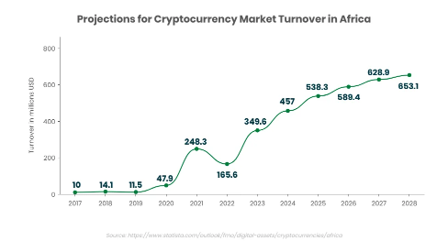
Based on the latest projections from Statista, the revenue from cryptocurrency in Africa is expected to reach $2.9B this year, with a yearly growth rate of 4.8%.
The number of users is expected to reach 53.89M users this year and user penetration rate is expected to increase 4.05%. The biggest drivers in cryptocurrency adoption on the African continent are South Africa and Nigeria, with both leading the way in terms of user engagement and regulatory frameworks. South Africa specifically had a 38% crypto growth in 2024 as per TechPression.
The top cited reasons by users in Africa for adopting cryptocurrency are:
- Economic Instability and Inflation: Many African countries experience economic instability and high inflation. Cryptocurrencies like Bitcoin and stablecoins, can serve as a hedge against inflation and currency devaluation.
- Limited Access to Banking: A significant portion of the African population lack access to traditional banking. Cryptocurrencies offer an alternative for financial inclusion, especially in rural areas.
- Cross-Border Remittances: Cross-border remittances are a major source of income for many African families. Cryptocurrencies offer a faster, cheaper and more efficient way to send money across borders.
- Young, Tech-Savvy Population: Africa has a large young tech-savvy population that is embracing digital technologies like cryptocurrency.
- Mobile Penetration: Africa has high mobile phone penetration rates, making it easier for people to access the internet. High mobile penetration has enabled Africa to leapfrog many develop countries in adopting digital finance.
- DeFI and Blockchain Technology: The growth of Decentralized Finance (DeFi) and Blockchain technology is also contributing to the rise of cryptocurrencies in Africa. DeFi platforms offer an easy way to lend, borrow and trade, services not available easily through traditional finance.
With the above information and the growth rate, it’s no surprise that the cryptocurrency industry has grown in Africa. However, there are also significant problems with current cryptocurrencies, whether Bitcoin, Ethereum, stablecoins or AltCoins.
Cryptocurrency Price and Wealth Inequality
One of the biggest hurdles in further adoption of cryptocurrency in Africa is the vast wealth inequality. The richest 10% of Africans hold a disproportionate share of the wealth, while the poorest half possess only a small fraction, often less than 1%. In South Africa, one of the highest developed countries in Africa, the World Bank’s Gini index places South Africa as the most unequal country globally.
The other main hurdle is the price of leading cryptocurrencies.
As mentioned earlier, 1 BTC is worth around R1.865M (around $103K).
The second largest cryptocurrency called Ether (on the Ethereum network) is worth roughly R47.2K ($2621.01). In South Africa, one of most developed countries in Africa, the average monthly salary is around R28 321.00 as of Q4 2024. The median monthly salary is approximately R27 200.00, meaning half of all workers earn more than this amount, while the other half earn less.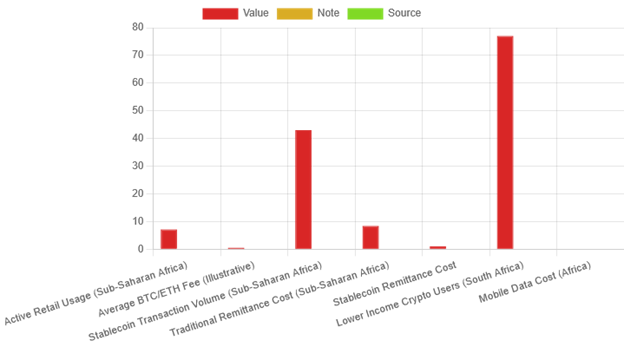
While not directly related, the unemployment in South Africa is 32.9%, with 46.1% for the youth of the country. This lack of income with the low levels of payment from welfare means that a significant portion of the country do not have a great amount of purchasing power and cannot fully participate in the economy.
Based on the above metrics, it is beyond the purchasing power of the average person in South Africa, let alone other African countries, to amass a good amount of Bitcoin or Ether.
Bitcoin requires highly expensive equipment to mine (using their Proof of Work consensus) that is environmentally hazardous, affecting our already strained power grid. Ethereum requires at least 32 ETH for staking on your own validator node (using their Proof of Stake consensus).
It could be argued that pooled staking, liquid staking or staking as a service could be use, but these platforms are often highly centralized and only offer a very small reward to the pool, unless they have significant ETH.A popular alternative has been stablecoins – a type of cryptocurrency where the value of the digital asset is pegged against a reference asset, which can be fiat currency, traded commodities or another cryptocurrency. Stablecoin adoption has grown in Africa tremendously. Circa September 2024, EMURGO Africa reported that the stablecoin volume hit more than $30B, which is 50% of the total crypto volume attributed to Africa between June 2022 and July 2023.
Most of these stablecoins are pegged against a fiat currency – specifically the US Dollar.
While this of course does give it real-world backing, it also in turn acts as a middle-man between the user and the fiat currency, somewhat defeating the concept of crypto as an alternative to fiat currency. Notably, if the US Dollar for some reason were to devalue, the value of the cryptocurrency will similarly drop. While it is more stable than many other types of cryptocurrencies, it is still volatile due to the aforementioned reasons.However, there are real-world assets that aren’t fiat that Africa is vastly rich in.
The Gold Standard
Most currencies today are pegged largely to their exchange rate to the US Dollar, the Dollar being the best-known fiat currency in the world. However, the Dollar wasn’t always a fiat currency.
Before 1971, the US Dollar was part of the Bretton Woods system.
It was convertible to gold at a fixed price, and most other currencies were pegged to the US Dollar. This changed in 1971 when President Richard Nixon decided that the US Dollar would be no longer be backed by a physical commodity like gold, but by government decree and trust in its value. This was referred to as the “Nixon Shock”, which had a global impact, as the US Dollar was the reserve currency for many countries, leading to worldwide adoption of fiat currencies.The big problem with fiat currencies is that it gives central banks greater control over the economy, because they can control how much is printed. While in ideal conditions, this is done responsibly, governments could also print too much of it, resulting in hyperinflation (which happened in both Weimar era Germany and Zimbabwe). A government could also have incentive to devalue a currency to pay for spending.
Where Africa fits in
Africa is rich in natural resources and commodities. In reference specifically to gold, in 2021 Africa produced 680.3 metric tons of gold, accounting for nearly a quarter of global gold mine production. South Africa, despite having diminishing production, still holds an estimated 6000 tons of gold, the second-largest reserve-base globally. Other African countries like Algeria, Egypt, Libya, Ghana, Mali and Zimbabwe also have large reserves.
Africa is truly rich in gold – so why aren’t we using this to peg cryptocurrency?
A gold backed cryptocurrency would be far less volatile than traditional cryptocurrencies and its value fluctuates less than fiat currency. Africa has the mineral wealth to truly claim its stake in the digital economy if we stake a cryptocurrency against gold – hence our idea: A Pan-African cryptocurrency that will be pegged against gold.The Coin Afriq Project
Coin Afriq was borne out of the idea that there needs to be a modern, secure Pan-African cryptocurrency with low barriers for entry so that ordinary people on the African continent could truly participate in the economy.
I was approached by the Founder and CEO of Coin Afriq, Mr. Hannes Uys, with the idea of a new cryptocurrency that could be used across Africa and actually be affordable so that ordinary people could participate – not just those with wealth, and not exclusively to those who are tech-savvy. Thus began the journey.
Mr. Uys has 30+ experience in the gold industry – specifically starting gold mines and acting as CEO for many companies across the EMEA and ASEAN regions. We both saw the advantage of eventually pegging our new cryptocurrency and blockchain to gold.
As a developer and ardent researchers, I decided to see if we can’t find a way to create this new blockchain as a more fair, democratic and decentralized system – values in line with the original vision of cryptocurrency.
We engaged in talks with various players in the crypto industry – both consumers and founders, on what they thought a new cryptocurrency should do, along with technical ideas I had formulated and the vision of our Founder.
Architecturally the decision was reached that this cryptocurrency should have the most fair and democratic system possible. As Co-Founder and in charge of the technology stack, I knew this had to be a Nominated Proof of Stake system.
Nominated Proof of Stake (NPoS) doesn’t only take into regard how much coin you already possess, but lets nominators elect their validators and base it on their merits, after which an algorithm ensures random distribution to ensure no undue centralization can occur.
By consulting with the crypto community, we heard their feedback and implemented features such as:
- Post Quantum Cryptography
- ISO20022 Support
- High Interoperability with Other Networks
- Smart Contracts
- Support for Decentralized Finance, Decentralized Applications and Derivative Tokens
A secure language would be needed that could be extensible, but easy for developers to learn.
Ethereum created Solidity for this task – I decided the logical decision would be Rust.
As Rust is a highly performant, secure and typesafe language that is favoured by many developers, this would mean easy adoption. My search also led me to a framework which uses Rust, has high interoperability, and has Smart Contract capabilities rolled-in – Hyperledger Iroha2.A challenge was: how could we get ordinary people to start using cryptocurrency?
Our answer was to build not only the cryptocurrency and blockchain, but also a suite of applications.
Coin Afriq Website and Imali Wallet
We settled on the idea of having the capability for users to buy, sell, trade and stake on our website and to develop a dedicated non-custodial wallet called the Imali Digital Wallet with these same features that could be published for both mobile (Android and iOS) and desktop (Linux, macOS and Windows).
By utilizing free and open-source software for both the web (NextJS, WordPress, APIs) and mobile (Tauri v2, APIs), we could effectively do the above and significantly reduce development time.
A very ambitious goal and project, the key question being: is it financially feasible?
Economic Feasibility of Coin Afriq
We decided to carefully work out the tokenomics of Coin Afriq (CAFQ ticker).
We settled on the low initial price of R10.00 per coin at launch, with pre-sale at R6.80 and Initial Coin Offering (ICO) at R8.50 per coin.Engaging with a dedicated listing agency, market maker and crypto marketing agency, we had a solid plan. We decided to conservatively map out the data:
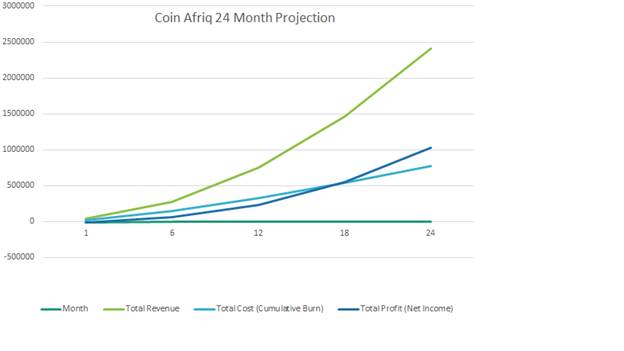
In this 24-month projection, we calculated the data as follows:
- Total Addressable Market (TAM) – $2.9B
- Serviceable Addressable Market (SAM) – $17.4M
- Serviceable Obtainable Market (SOM) – $1.74M
At a calculation of our SAM being 0.6% of the TAM – a very conservative figure, and capturing a SOM of 10% of the SAM based on cohort analysis, the figures clearly indicated a massive potential within 24-months not just for investors and the company, but also a significant impact on the cryptomarket, particularly in South Africa – a key player in crypto in Africa.
This all was calculated as only from constant income i.e without the sales from pre-sales, ICO or airdrops.
This also showed us based on cohort analysis that we could have a comfortable Long-Term Value (LTV) of roughly $64.80 and Cost of Acquiring Customer (CAC) at roughly $16.20 calculated per user over 24-months. This shows an LTV to CAC ratio of 4:1, which is considered a great investment.
We see even greater potential when we look at a 5-year financial projection based on the project data and factoring our milestones and roadmap.
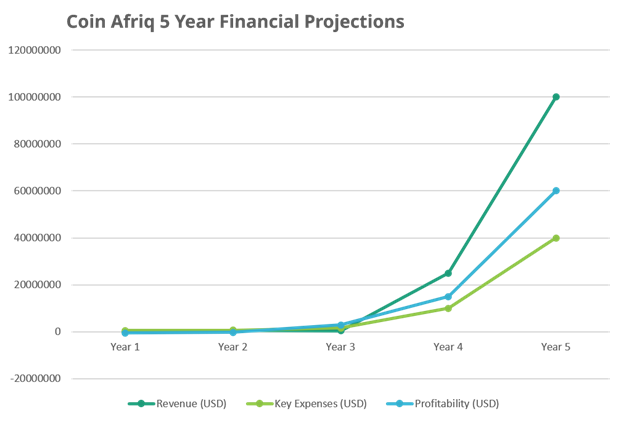
This is a staggering $60M Annual Recurring Revenue (ARR) by solely following our business plan and carefully following our roadmap and milestones. This figure could even be higher when factoring in the gold peg, expansion across Africa and the minting of more coins from our soft total supply of 10M CAFQ.
We based these figures according to these reliable defensible assumptions:
- Phased African Expansion: Focused market entry reduces risk, optimizes learning.
- Gold Peg = Trust & Adoption: Unique stability drives user growth in Africa.
- Growing African Digital Payments: Large, expanding target market.
- Network Effects Fuel Growth: Increased user base enhances platform value.
- Lean & Scalable Operations: Efficient tech enables cost-effective growth.
- Ecosystem Monetization: dApps/DeFi provide additional revenue streams.
- Realistic Market Share: Conservative projections with significant upside.
- Data-Driven Optimization: Continuous learning informs strategy.
With these figures, data and key-points, we can iterate our roadmap as follows:
Phase 1: Foundation & MVP Development (Currently in Progress)
Key Objectives:
- Finalize core blockchain architecture leveraging Rust and HyperLedger Iroha2.
- Complete development and internal testing of the Minimum Viable Product (MVP) showcasing:
- Core transaction functionality with CAFQ.
- Implementation of post-quantum cryptography (ML-KEM and ED25519).
- Demonstration of Byzantine Fault Tolerance.
- Basic wallet functionality.
- Initial showcase of smart contract capabilities.
- Establish core team and operational infrastructure.
- Secure strategic early partnerships.
Phase 2: Pre-Sale & Community Building
- Key Objectives:
- Launch and execute the pre-sale event for early supporters and strategic investors (10% of total CAFQ supply at R6.80 per CAFQ).
- Actively engage and grow the Coin Afriq community through dedicated channels.
- Expand marketing and awareness campaigns.
- Finalize legal and regulatory frameworks for initial launch.
- Secure initial partnerships for ecosystem integration.
Phase 3: ICO & Mainnet Launch (South Africa Focus)
- Key Objectives:
- Conduct the Initial Coin Offering (ICO) for the wider public (up to 15% of total CAFQ supply at R8.50 per CAFQ).
- Successfully launch the Coin Afriq Mainnet.
- List CAFQ on a Tier 2 Centralized Exchange (CEX) with a dedicated market maker focused on liquidity.
- Drive initial user adoption and transaction volume within South Africa.
- Onboard early dApps and DeFi projects to the platform.
- Implement the initial network transaction fee structure (0.5% with burn mechanism).
Phase 4: Building Towards Gold Pegging
- Key Objectives:
- Focus on generating sustainable revenue from network operations within the South African market.
- Strategically explore and establish partnerships within the mining sector, leveraging the founder’s expertise, to secure consistent access to gold resources.
- Research and develop the specific mechanism for pegging the value of CAFQ to gold (direct backing, stablecoin model, etc.), prioritizing security and transparency.
- Begin accumulating initial gold reserves based on operational profits and strategic acquisitions.
- Develop transparent and auditable systems for managing and verifying gold reserves.
Phase 5: Gold Peg Implementation & Initial African Expansion
- Key Objectives:
- Officially implement the gold-pegging mechanism for CAFQ, communicating the details and benefits to the community and potential users.
- Initiate strategic expansion into 2-3 key neighboring African markets, leveraging the enhanced trust and stability offered by the gold peg.
- Focus on early user acquisition and establishing use cases within these initial expansion regions.
- Continue growing the developer community and the number of dApps and DeFi solutions on the platform, highlighting the stability of CAFQ.
Phase 6: Broader Pan-African Expansion & Advanced Features
- Key Objectives:
- Broader expansion across the African continent, adapting strategies for diverse markets, now with the added advantage of a gold-backed currency.
- Focus on large-scale partnerships with businesses, financial institutions, and potentially governments, emphasizing the stability and store-of-value proposition.
- Implement advanced features such as derivative token support and enhanced interoperability.
- Evaluate and potentially pursue listing on Tier 1 Centralized Exchanges, leveraging the credibility of the gold peg.
- Further refine and optimize the network fee structure and burn mechanism based on usage and community feedback.
The result of this plan would not only be a disruptive technology in terms of cryptocurrency and blockchain, especially on the African continent, but also a rich ecosystem that’s extensible, scalable and robust.
Conclusion
Coin Afriq offers a breakthrough technology based on sound financial data, next-generation technology and humanistic values such as fairness, equality, democracy and decentralization.
We are excited to share more of our project as it develops.If you want to know more, feel free to email us info@coinafriq.org
We are also actively looking for investors to launch this groundbreaking project.
Share this article as much as you like, spread the word.
We want as many people to participate as possible so we can build a Coin for Africa – made by people in Africa for Africa!